Went for a crawl today

Went for a crawl today, but just a short crawl. It was at the end of a walk, but just a short walk and it seemed the best way to proceed. And no, no alcohol was involved in my choice of ambulation although my destination was on the rocks and it involved lots of ice. Perhaps I should explain, just a short explanation, promise. We finally had a snowstorm here in Vermont, not a biggie but enough to cover the ground and coat the trees. I wanted to practice some video so I headed to a nearby river- Big Branch in the Green Mountain National Forest- about 4 miles from my house. Turns out that the recent thaws and hard freezes we have been having have built up a lot of ice in the streams and rivers in the area. When I got to the river there were only a few holes of open water but the ice seemed thick enough to hold me so tripod in hand I crawled on hands and knees to the lip of a hole and peered in. I mean, what could go wrong? Well, let’s see…I screwed up my first exposures- too dark. When I went to Live View for video I couldn’t remember how to start the video and my shutter speed was way off. I also forgot to mount my external mic with the dead cat (that’s the term. It’s the shaggy furry thing you see on shotgun mics) in my hot shoe so the first couple of videos sounded very tinny. Oh, and I also didn’t bring a long enough lens to get good close-ups on the icicles on the far side of the holes. Did I mention it was cold? I did manage to get a few shots and some video footage. Mostly B-roll (I don’t really know what that means but I like using the term whenever I can) but I think with some help I can stitch some video and stills together for a nice little winter stream piece. The images included here are the best ones I got. It’s going to be very warm tomorrow followed by another hard freeze so I am going to go back in a couple of days to get some close-ups (with my telephoto lens- my macro is too short to reach the icicles). I’ll add these to the mix and in a few weeks after considerable frustration I’ll share the final version with you. I’ll include a piece of the B-roll to give you an idea of what the river was like. Enjoy! <iframe src=”http://player.vimeo.com/video/58507565″ width=”500″ height=”281″ frameborder=”0″ webkitAllowFullScreen mozallowfullscreen allowFullScreen></iframe>
A Fresh Image

Taken with my iPhone. That’s the cow’s breath, a tad fresh inside the barn. Not the best picture (I was in the middle of chores!), nice idea though- I’ll be working on this some more.
Photographing Cold

Speaking of cold…have you ever tried to photograph cold? Not photograph in the cold, we have all done that more or less successfully. What I mean is photographing the concept ‘cold.’ Take a picture that captures the concept cold. I have tried for 10 years or more and have yet to really get a good one. A winter shot is not a cold shot. I want a picture that makes you shiver. Photographing a concept is not an easy thing to do. I struggled a lot with trying to photograph the concept ‘big’ when I was doing my book on the old-growth forests of the Northwest. I eventually figured ‘big’ out (photograph a normal-sized tree in front of a looming big tree) and I have figured out ‘wild,’ ‘Vermont,’ and each of the seasons but I haven’t gotten a great shot of ‘cold’ yet. An icicle doesn’t work, neither does ice on a pond or puddle. Someone shivering might work but I haven’t come across that. So I’m still looking. Tomorrow it is going to be really, really cold, or ‘some fresh’ as we say on the farm. I’m going to see what I can come up with. Wish me luck! ) (and warmth!)
How cold is it?
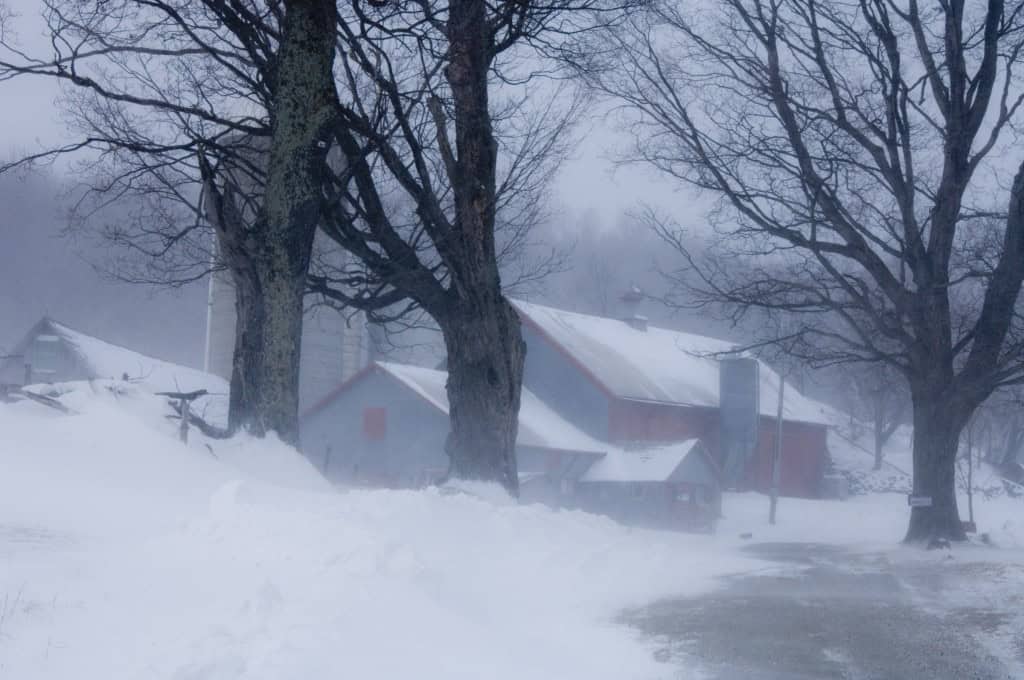
On the farm we never say it is cold, it gets too redundant. If it is November, December, January, February or March chances are it is cold. We only comment on the weather when something unusual happens- a hurricane comes through, a tornado touches down, cats and dogs drop from the sky, etc, etc, etc. In winter we only mention that it is cold obliquely, we never actually say it is cold. I think if we actually admit it is cold than we also admit that it is a long way from being warm. So how do we acknowledge that the temperature is a wee bit low? We say “It is a bit brisk” when the temperature gets down into the 20’s- really hardly worth mentioning. We say “It is brisk” when the temperature is in the teens- noticeable but barely. We’ll put a vest on (mostly for looks). We say “It is fresh” when the temperature is in the single digits but only when the wind is blowing. Otherwise we go out and cut wood. We say “It is a bit fresh” when the breeze kicks up in the minus single digits and ears begin to get chilled. We will zip up jackets at this temperature. When it is actually cold we say “It is some fresh” but only when the temperature drops down to the minus teens or below and the wind is howling. We only say “some fresh” when we are inside because it is so cold, er…fresh outside that the temperature grabs your words and tosses them back down your throat before they get very far making anything more than a garble difficult. This is also called hat weather. When it is some fresh Roger will wear three pairs of socks, long underwear, two pairs of pants, three or four shirts, a down jacket, a scarf, a hat and maybe another. We don’t look at a thermometer when it is some fresh, we don’t need to. It is some fresh when there is an inch or more of frost on all the nails and metal handles inside the barn and we warm our hands on the utters of cows and around lit lightbulbs. When it is some fresh, cold is just another layer that Roger puts on in the morning and doesn’t take off until he slips into bed at night. Tomorrow it is going to be some fresh on the farm at 6am. I know this because it is already minus 10 windchill and we have hours of night in the freezer still to go. At least I expect so. I’ll still be in bed. I’m not an idiot! I’ll get over there when it is back to being brisk. That’ll be sometime in March.
Some Really Terrible Pictures!

I thought I would make all of your collective days and give you some inspiration at the same time…I’m going to show you the worst images I ever kept and were proud of! That’s right, these three images were my all time favorites at the time, my best of the best! Scary, huh? I took these shots in 1975- 37 years ago. Needless to say I didn’t have the faintest idea what I was doing. I had a Nikon Nikkormat FTn camera, some Kodachrome 64 film and lots of time on my hands. What I didn’t have was even the smallest clue what to do with any of it! So this is where I started. These horrid images were my prizes- I gave them away as presents to long suffering friends and family. Cruel of me, I know, but even crueler is the fact that some are still in circulation- hidden on dark walls of guest bathrooms at my brother’s house and mercifully stuffed in a drawer of at my Mom’s. Now think how good your images are compared to these. If I can get to where I am now starting with this dreck, imagine to what great heights you can go starting from where you are now. All it takes is practice, lots and lots of practice, and that just means going out and taking more pictures. Not the worst thing in the world to do!
Thinking Like a Pro- The best way to get better
I have realized over the years of teaching workshops and critiquing portfolios that the one question I am always asked is “What should I do now?” This question is usually asked by people who have been to all the standard places and that have taken all the standard shots of all the standard things. The portfolios I see are beautiful, don’t misunderstand me, but I see the same shots over and over again and there is always something missing. So what am I complaining about? Let me explain. You can look at a portfolio of all the top spots to photograph in several ways. You can say that it is a wonderful accomplishment that shows years of dedication of photographing America. You can say that imitation is the highest form of flattery. You can say that it is a very efficient way to see and photograph all the best places in the United States. You would be right each time. But the problem is that all your best images are individual images with no or maybe little relationship to all your other images. You are spending your time trying to get single pretty shots. Then what? You spend more time trying to get even prettier shots. And even prettier shots, and even prettier shots. STOP! There’s a better way. Rather than spending your time traveling all over the place skimming the cream I suggest that you give yourself a photo project or two to work on. By concentrating on a project or theme you become more motivated and go deeper into your creativity. Suddenly, your photography becomes more satisfying as you explore something you are passionate about and your images become more personal and original. Plus, working on a project is a great way to really improve your photography. A project can be anything. It can be different ways to photograph flowers or photographing the natural areas near you. Some people pick a concept such as ‘windows’ and photograph that. Others spend a month shooting with only one lens. Another terrific way is to take a workshop and allow yourself to concentrate on your photography and just your photography with help and inspiration just a holler away. When I moved east to Vermont I decided to reacquaint myself with the state by systematically exploring as much of it as I could. For five years I wandered every road, path or river in Vermont I could. I studied Vermont picture books, calendars and post cards whenever I could and I bought every guidebook I could that specialized in anything outdoors. At the time, it was the most satisfying time of my professional life. My attempt to get to know the wild side of Vermont grew into two projects. One was to photograph the everyday nature of Vermont and the other was to keep notes of the places that I found to photograph. Those two projects grew into two books. One, The Nature of Vermont, highlights the wildness found roadside, streamside and even barnside in Vermont and the other, The Photographer’s Guide to Vermont, is a site guide for all photographers who visit Vermont. My efforts didn’t have to lead to two book projects. I was using the images for magazine articles, calendar submissions and slide shows. I could’ve also parlayed the effort into public presentations or gallery shows. I could’ve done posters and note cards or sold the images on my website. Doing a project didn’t limit me in any way. In fact it forced me to expand my photography. When you pick an area of concentration you will begin to see your photography differently. At first your compositions are pretty much everyday stuff – not bad but just like everyone else’s. But then as you take more pictures your compositions and subjects became more interesting, more sophisticated, more original. Suddenly you start to notice things that before you would’ve overlooked and you start seeing the everyday anew. For me, making the ordinary extraordinary is the most satisfying thing I can do photographically. The only way to do this is to slow down and give yourself time to explore both your outer and inner landscapes. The best part of this process is that because I have allowed myself to concentrate on a theme or two I am getting shots nobody else has because nobody else has taken the time I have. This will work for you as well, I promise. And wouldn’t you know I offer a workshop exactly on this topic! The workshop will give you all the tools and ideas for you to start your own project. I will even help you crystalize your project ideas into strong, viable photographic themes. It’s a great workshop and your photography and enthusiasm will only get better. Promise
Bird Photography
This post is from my great friend Jeff Wendorff. In my considered opinion, Jeff is the best bird photographer I know of- period. This is a short article he put in his blog recently about how many pro bird photographers get their great shots. Elephant Head Pond is open to anyone. So don’t lament if you are a bird photographer, get ye out to Amado, Arizona and get these same spectacular shots! Now to Jeff- I really really enjoy bird photography for a lot of reasons, but the main reason is the satisfaction of making a really nice bird photograph. A lot more goes in to bird photography than most people imagine. You need bird knowledge, good equipment, patience, luck and a good location. While I am still working on the first 4, I do know a super location, the Elephant Head Pond near Amado, AZ. It’s a 45 minute drive south of Tucson and if you are a bird photographer it is well worth the trip. Bill Forbes has been feeding and providing a constant water supply to the birds on the ranch for years and so there a lot of birds coming and going providing lots of photo opportunities. To make the whole thing work he has several blinds situated around the pond and the feeders. In addition, he has many perches for the birds to use that are all natural and are situated to bring the birds in close proximity to you and your camera. If you’ve ever walked the forest looking for birds to photograph you know how tough that can be. You also know how hard it is to get the bird in nice light, in a clean background, in close range and in focus! Shooting from a blind in a bird hotspot like the Elephant Head Pond is a whole new world. You’ll often be faced with too many birds all in perfect conditions, that doesn’t often happen in a forest. The first time you shoot from setups like this you are going to be shaking your head and mumbling to yourself, “This can’t be right, how is this going to work?” Let me show you behind the curtain. Click the images to embiggen. I told you that you would be scratching your head! All of the perches that you see surround in the pond (yes, that is the “pond”!) are designed to be moved and changed as you see fit. All of them have hidden feeders to attract the birds to land for you. The perches are movable so that you can have a wide range of looks to your photographs, you don’t want all of the birds you photograph to be on the same perch. The second reason that you may want to move them is attract a bird to a specific perch. When the birds have a lot of choices for landing spots, it is near impossible to get the shot on the perch you want. Removing the number of choices increases your odds. This desertscape is the one that you see in the back of the first image. Here are a couple of shots that I made using that tabletop perch. Now you can see how the perch worked to help me photograph two very different images from the same setup and since we are only focusing on bits and pieces there is no sign that this is a perch built to make this image possible. Also, note that I am able to get the perfect eye level shot of the bird. The bonus is that I am sitting in a chair and not laying on the desert floor with the snakes and scorpions! I only had time to spend a half day at the ranch on this trip, but the next time I’d probably do 2 or 2 and half days and really work on the perches and the setups for some added variety. I was there last week (first week of December 2012) and the full variety of potential birds wasn’t around. I did manage to photograph 17 species and if you count male and females 23 birds. Not a bad morning! Here is my list of the birds that I photographed. I don’t think I saw any birds that I didn’t manage to photograph. Well, there was a Merlin and a Cooper’s Hawk that made a couple of passes trying for a snack (unsuccessfully) and I didn’t get those birds… Black-chinned Sparrow Brewer’s Sparrow Cactus Wren Canyon Towhee Curve-billed Thrasher Gambel’s Quail Gila Woodpecker Greater Roadrunner Green-tailed Towhee House Finch Ladderback Woodpecker Mourning Dove Northern Cardinal Northern Mockingbird Pyrrhuloxia Rufous-Winged Sparrow Verdin Desert Cottontail Rabbit Antelope Ground Squirrel It is not all feathers at the pond sometimes furry friends come to drink and be photographed as well. The squirrels were a fun diversion during the occasional lull in the bird parade… Here is the link to Bill’s website and you can see his (incomplete) list of possible species as well as directions and rates. I can’t say enough good things about his help and just the way he runs the operation. A quality person and a quality photography location. I am thinking of running a photography workshop there next spring or perhaps next fall. Please leave me a comment if you’re interested and I’ll keep you posted on the potential of a photography workshop at the pond. I should also mention that I was shooting at 400-600mm (full frame) for most of the images that I took. A few of them were made at 200mm. I would think that in general you will need to be able to reach out in the 400-600 range either with crop factors or tele-converters. Click any image to show full size slideshow view. Click on the X in the top left corner to exit the slideshow view. I’ve made a collection in my portfolio of all of the images that I made while I was at Elephant Head Pond. It will give you a chance to see the diversity
Happy New Year!

Tis the New Year. See that indiscrete path ahead of you? It is waiting for your energy and vision to lead you to great photographic riches in this coming year. It will go where ever you wish it to go- you can choose to tread the familiar old paths or you can turn and explore new territory. Might I suggest a little exploring this year? It’s up to you but what have you got to lose? And what wonder and joy have you got to gain!! Time to step out and start your photographic year. Where will your photography path lead this year?